Pocket Watches

Curated specialists in antique and vintage pocket watches.

Family-owned Melville, Long Island watch repair shop doing overhauls and restoration on luxury and everyday brands, walk-in or by mail from across the US.
Family watch repair shop in Cranston, RI, rooted in a 1940 watch hospital, servicing a wide range of brands in its own workshop and by nationwide mail-in.
Family-owned Massapequa, New York watch repair shop, established 1973, that finishes every repair on its own premises and accepts watches by mail.
Owner-run, home-based watch repair shop in Troy, Michigan, where Stefan Mihoc, who spent 11 years in watch manufacturing at Shinola Detroit, does every repair.
Mount Joy, PA watchmaker founded in 1992 by Roland G. Murphy, Fortis's US service center, repairing modern, vintage, pocket and complicated watches by mail.
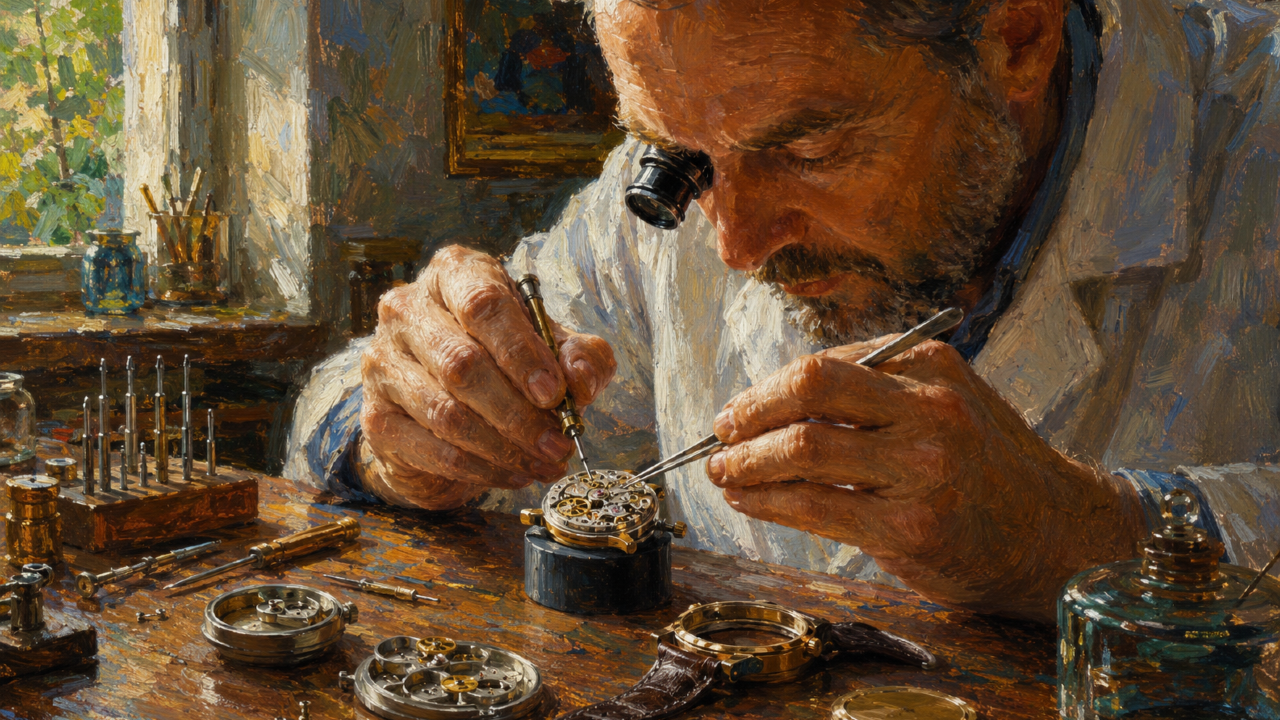
Independent watch and clock repair by mail from Fort White, Florida: high-grade mechanical and vintage watches, plus antique clocks. Call first to ship.

Pocket Watch Repair & Service

Pocket watches bring their own service questions: movements more than a century old, makers long gone, parts that may have to be found or made, and cases that were often fitted by a jeweler rather than the factory. Below are the main choices owners face, with what watchmakers, the NAWCC and collectors commonly say on each side. Whether the watch is a family heirloom, a working railroad piece or part of a collection shapes which way you lean, and that is your call. The providers on this page work on pocket watches; ask each one how they approach the choices that matter to you.

Conserve or restore

  • Conserve. Minimal intervention that keeps the existing material, including later repairs that are now part of the watch's history. The watch may stay cosmetically worn or not fully working.
  • Restore. Returns the watch toward its presumed original state and full function. It can remove or alter material that is part of the object's story.
  • Where opinion divides. The Antiquarian Horological Society's report on a British Horological Institute forum on this subject found supporters of each approach and many in between. Independent watchmaker Andreas Strehler holds that replacement parts should be identifiable as replacements to a future specialist.

Replacement parts: factory, old stock, donor or made

  • Factory or new-old-stock parts. Match the original dimensions and keep the watch period-correct. Supply comes from old stock and watchmaker estates, and the same part number can come in several size variants.
  • Donor movements. A part from a "parts" movement of the same model when no new part exists. The donor part is itself used and may be worn.
  • Made by hand. For rare or obsolete movements, a watchmaker can turn a part such as a balance staff on a lathe. It takes specialist skill and time, and repairers willing to work on older watches are few.
  • Availability depends on the maker. Pocket Watch Database says many parts for American makes are still readily available. David Boettcher, who writes on English and European watches, says replacement parts for old watches are usually no longer available. Both can be true for different watches.

Mainspring: period steel or modern alloy

  • Keep or reuse a blued carbon-steel spring. Period-correct. Old carbon springs lose power over time and can break, and a break releases energy that can damage pivots, jewels and wheel teeth.
  • Fit a modern alloy spring. Resists breaking, setting and rust. It is not the original material, which may matter for strict originality. The claim that alloy springs are too strong for old movements is still repeated; Boettcher calls it incorrect.

Enamel and metal dials

  • Leave an enamel dial as it is, or clean it. Enamel dials can develop hairline cracks and chips. Cleaning can make hairlines less visible, but the NAWCC encyclopedia warns that decoration printed on top of the glaze is easily damaged, and forum posters disagree on whether ultrasonic cleaning can extend cracks. The NAWCC also says a watch with a replacement dial is worth significantly less than one with a reasonable original.
  • Restore or fill it. Improves appearance, but collector guides such as Heritage Auctions advise seeking original dials where possible.
  • Replace it. A clean look. Many replacement dials were made by third parties, not the factory.
  • Metal and painted dials can be stripped and refinished. Collectors are split: some see any refinish as "restored, not original", others say a correctly restored watch sells for more.

Cases

  • Know the metal first. Solid gold, gold-filled (gold sheet over a base metal), rolled-gold plate and coin silver behave differently under refinishing. A guarantee stamped in years points to a gold-filled or plated case; worn-through areas showing base metal ("brassing") rule out solid gold.
  • Leave the wear, or replate. Leaving it is authentic but the base metal shows. Replating gives an even color, but a poster on a repair forum notes the result does not look like original gold-fill. Polishing removes metal and can reduce value.
  • Hinges. Rebuilding a worn hinge is skilled bench work that adds new metal to the case.
  • Original case or a "marriage". Most American movements were sold uncased and fitted to a case by the jeweler, so the original pairing was often the buyer's choice. The NAWCC encyclopedia sets out both views: some collectors hold the pairing must always be preserved, others see nothing historically significant in it. It names Ball (for US sales) and E. Howard as exceptions that sold complete watches.

Railroad-grade watches

  • Service and time it to its adjustments. Keeps what made the watch railroad grade: timing in positions and across the mainspring's run. It needs more bench time, skill and correct parts.
  • Service it for general running. Simpler, but the precision the watch was built for may not be realized.
  • What "standard" meant. The NAWCC encyclopedia says a railroad standard watch is one that met the rules in force when it was made, that different railroads accepted different watches, and that requirements such as lever setting evolved over time. Hunting cases and Roman dials were accepted into the 20th century. Fixed "1893 checklists" found online do not match this history.

Key-wind, fusee and cylinder movements

  • Specialist repair. Replacing a cylinder is expensive specialist work, and fusee and verge movements also need specialist skills. Boettcher describes the number of repairers who can replace a cylinder as small and dwindling.
  • Leave it as it is. Avoids damage in unskilled hands, but the watch stays stopped. Boettcher notes that repairing a cylinder watch may be uneconomic, because most are not highly valued.

Running it, and what it is worth to you

  • Carry or run it. You get to use it. Running a watch on old, dried oil builds up wear, which matters more when parts are hard to replace; a 1929 Gruen care booklet made the same point.
  • Display it, or service before running. Avoids wear, but the watch is not used.
  • Heirloom or market value. Owners often repair family watches for reasons a valuation does not capture. Boettcher notes that if a watch is kept purely for its monetary value, repairs usually cost more than they add, while auction guidance from Heritage Auctions stresses that original condition holds value best.
  • Serial lookup. The movement serial (not the case number) can identify the maker's grade and approximate date. The NAWCC offers serial resources for Waltham and Hamilton watches, and Pocket Watch Database covers makers including Elgin, Illinois, Waltham, Hamilton and Ball. Records have known gaps.

Before you ship, ask

  • Is this movement type (key-wind, fusee, cylinder, railroad grade) one you service regularly?
  • If a part is unavailable, will you source old stock, use a donor part, or make one, and will you tell me which before fitting it?
  • Will the dial, case or crystal be touched, and can I opt out in writing?
  • Will removed or replaced parts be returned to me with the watch?
  • Will the work be done on site, or sent elsewhere? If it is sent on, where does it go, and does the quote add a fee on top of the service center's charge?

Providers on this page were researched against our Standard at the time they were listed and are rechecked periodically. Details can change between checks, so confirm terms, pricing and turnaround directly with the provider before sending your watch.

Sources: NAWCC: Railroad watch, NAWCC: Pocket watch dials, NAWCC: Case material, NAWCC: Watch case, NAWCC company records, Antiquarian Horological Society, Andreas Strehler on restoration, Pocket Watch Database: parts, Pocket Watch Database: balance staffs, Pocket Watch Database: adjustments, Pocket Watch Database: gold cases, Pocket Watch Database: serial numbers, David Boettcher: mainsprings, David Boettcher: watch care, David Boettcher: cylinder watches, WatchRepairTalk on porcelain dials, WatchRepairTalk on refinishing dials, WatchRepairTalk on gold-filled cases, Ganoksin on hinge repair, David Boettcher on English watchmaking, Gruen 1929 care booklet, Heritage Auctions collector's guide.

Filters

Custom Fields

Accreditations & Memberships
Certifications
Capabilities & Specialties
Complications Serviced

Tags